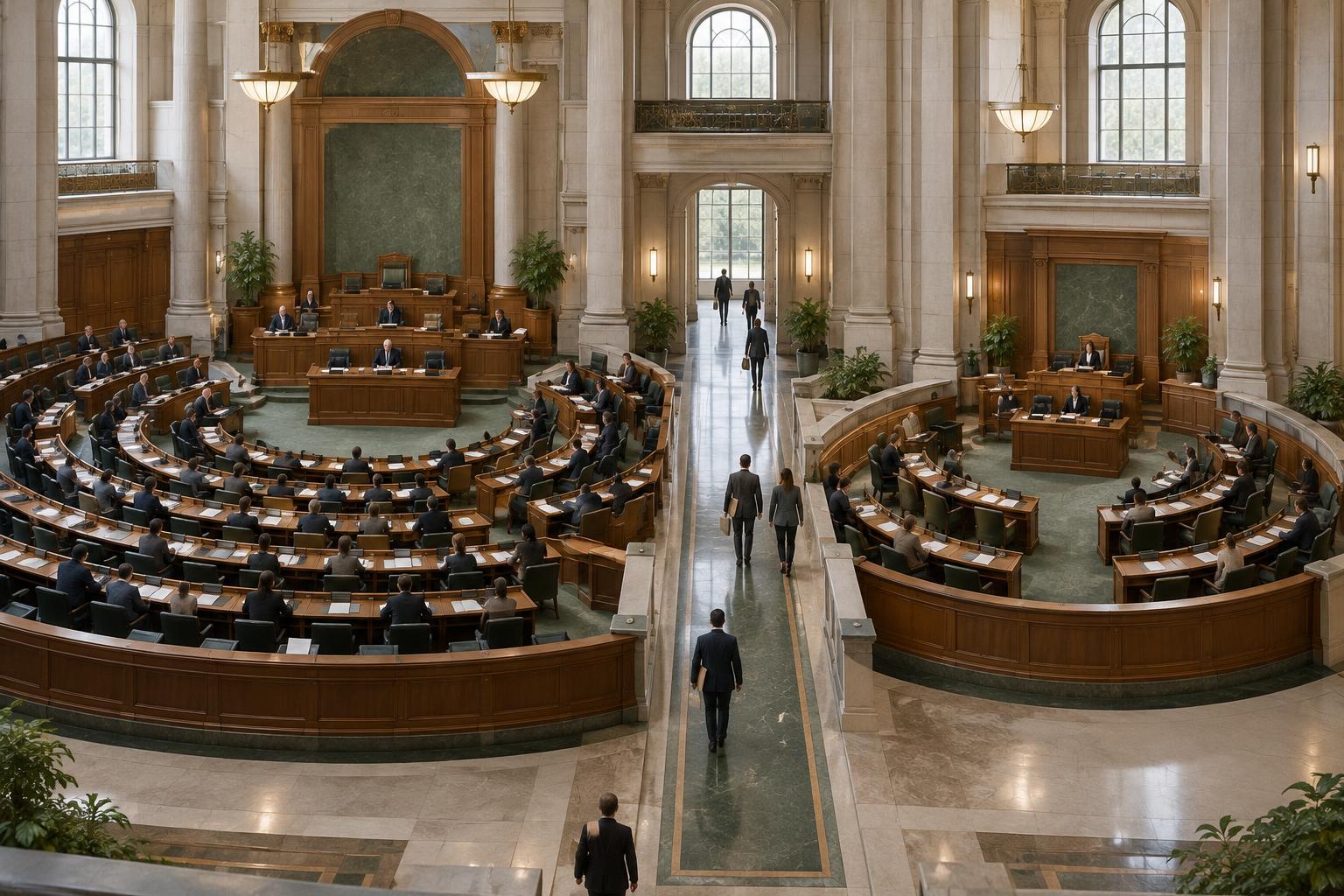
A framework for public power
A constitution is a set of basic rules for governing a political community. It identifies public institutions, describes what they may do, and explains how they relate to one another. It may establish a legislature to make laws, an executive to carry them out, and courts to resolve disputes. It may also divide responsibilities between national and regional governments. These arrangements help answer a practical question: who has the authority to make a decision?
Not every constitution takes the form of a single document. Some systems rely on several laws, judicial decisions, and established practices. Even where there is one central text, that text rarely explains every detail of government. Ordinary laws, legislative procedures, and political conventions fill in much of the day-to-day picture. For that reason, understanding a constitution means looking at both its formal rules and the institutions that put them into practice.
Powers, limits, and accountability
Constitutions do more than assign powers; they can limit how those powers are used. A legislature might have authority to pass laws but must follow rules for elections, voting, and public debate. An executive might direct government agencies but remain subject to laws and oversight. Courts may be able to review certain official actions, although the scope of that role differs across systems.
Rules about terms of office, appointments, budgets, and removal from office can make public officials answerable to other institutions or to voters. Dividing authority may reduce the chance that one office can act without scrutiny. It can also create disagreement or delay. Neither outcome can be understood from an institutional chart alone: much depends on how officials use their powers and whether other institutions can respond effectively.
A constitution may also state that some rules have a higher status than ordinary legislation. Where that principle applies, a regular law cannot validly override a constitutional rule through the usual lawmaking process. Systems differ, however, in who decides whether a conflict exists and what remedy follows.
Rights on paper and in practice
Many constitutions recognize rights or principles intended to protect people from certain uses of public power. These may concern expression, participation in elections, equal treatment, fair procedures, or other matters. The exact wording and scope vary. Some provisions state a broad principle; others describe a more specific rule. A constitution may also allow limits on a right under defined conditions, creating questions about how to balance competing interests.
A written guarantee does not enforce itself. People need ways to raise a complaint, and institutions need authority and capacity to respond. Courts, legislatures, independent oversight bodies, and administrative processes may each play a part. Access matters too: a remedy that is difficult to seek may offer less protection in practice than its wording suggests. Constitutional rights are therefore best understood as both commitments and working arrangements that must be applied in real cases.
Interpretation is unavoidable when general language meets an unexpected situation. Disagreement over a provision does not necessarily mean its words are meaningless. It often means that institutions must give reasons for choosing among plausible readings, while working within the procedures their system provides.
Changing the rules of the system
A constitution usually provides a way to change its own text or basic rules. An amendment process might require approval by more than one institution, a larger-than-usual legislative majority, a public vote, or agreement from regional governments. Such requirements are designed to make fundamental change more deliberate than passing an ordinary law. If they are too difficult to meet, however, a system may struggle to adapt through formal channels.
Not all constitutional change happens through amendment. Court interpretations, new laws, and long-standing political practices can alter how the framework operates without changing its text. These routes are not interchangeable: an interpretation must address what an existing rule means, while an amendment can revise the rule itself. Arguments over which route is appropriate are often arguments about who should have the authority to decide.
When examining any constitution, three questions offer a useful starting point: who can exercise power, what limits apply, and how can the rules be changed? A fourth question makes the picture more complete: are those rules followed and enforced? A constitution can provide a durable framework, but its effect depends on the people and institutions that work within it.