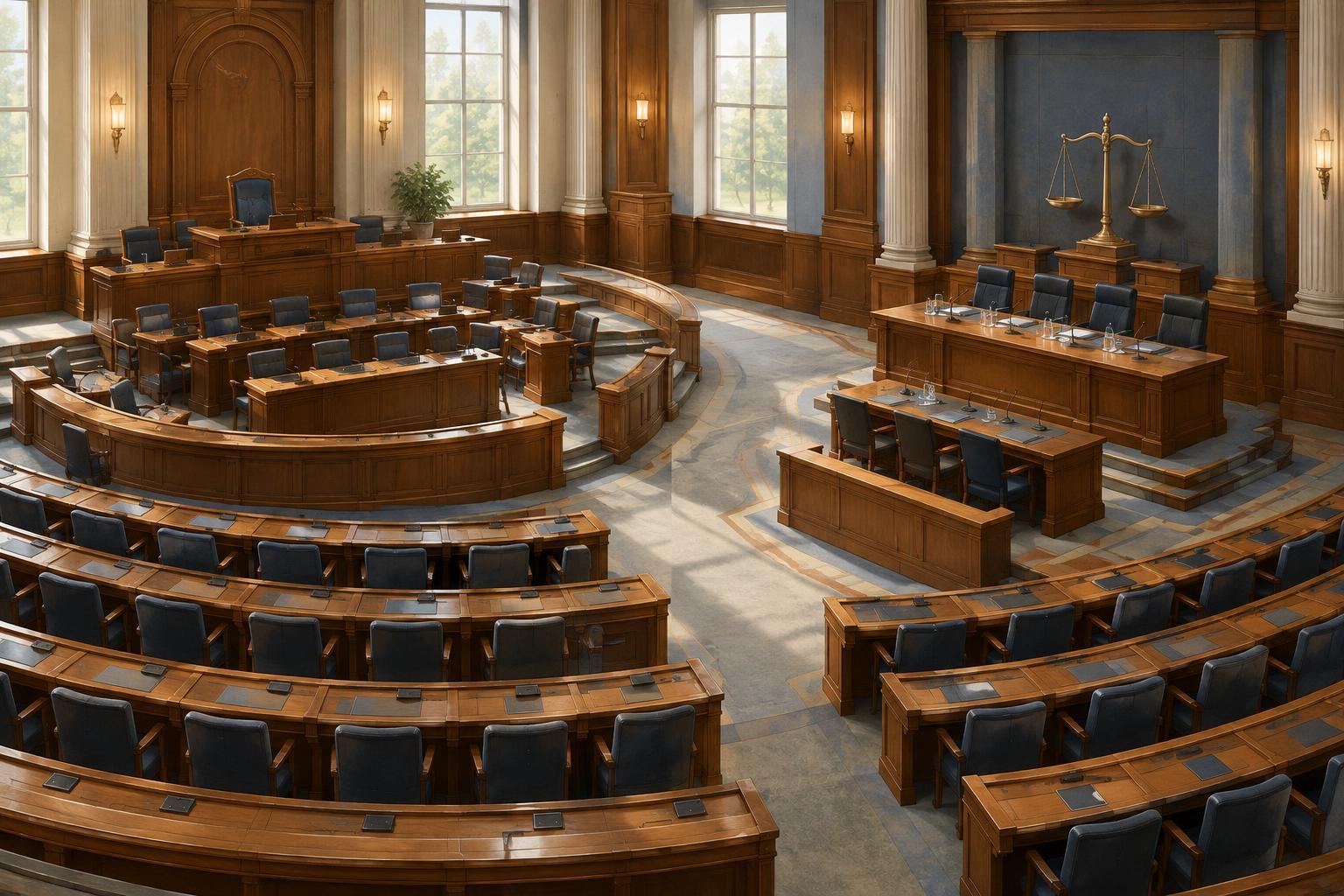
Two questions about accountability
A vote of no confidence and impeachment may both make headlines when a leader’s position is in doubt. Yet they are not interchangeable. A confidence vote asks whether a government can still rely on enough support in the legislature to govern. Impeachment is generally a formal process for bringing allegations of serious misconduct against an officeholder. Neither term describes one identical procedure across all countries.
The distinction reflects different relationships between political branches. In a parliamentary system, the executive is typically drawn from, and remains dependent on, the legislature’s support. In a presidential system, a president generally serves a separate term and does not need continuing legislative confidence to stay in office. Constitutions and parliamentary rules determine the precise mechanisms available in any particular system.
What a vote of no confidence does
A vote of no confidence is a legislative test of support for a government, often led by a prime minister. Legislators may withdraw that support because they disagree with policy, doubt the government’s ability to pass legislation, or object to its leadership. They need not necessarily allege wrongdoing. Conversely, a government accused of poor judgment might survive if enough legislators continue to support it.
If a government loses a confidence vote, the result depends on the applicable rules. Its leader might resign, another leader might attempt to form a government, or an election might follow. Some systems require legislators seeking to remove a government to agree on a replacement at the same time; this is often called a constructive vote of no confidence. Other systems allow a straightforward vote against the sitting government.
Not every close legislative vote is a confidence vote. A government can lose a vote on a policy proposal and still remain in office unless the rules or political circumstances make that defeat a test of confidence. This is why the wording of a motion, parliamentary procedure and the government’s own position matter.
What impeachment does
Impeachment concerns alleged conduct rather than the ordinary question of whether an officeholder has enough political support to govern. Depending on the constitution, it may apply to a president or other officials and may involve allegations such as abuse of office or other specified grounds. Its purpose and scope must be understood through the rules of the particular jurisdiction, not through a single universal definition.
In many systems, impeachment is a staged process. One body may formally accuse an official, while another conducts a trial or makes the final decision about removal. An impeachment vote can therefore be a significant step without itself removing the person from office. The required thresholds, available defenses and possible consequences vary.
Impeachment is also distinct from an ordinary criminal prosecution. The same conduct might raise questions in both settings, but the proceedings can have different purposes, decision-makers and standards. A political body’s decision about officeholding should not automatically be read as a criminal verdict.
Comparing the consequences
Consider two hypothetical situations. In the first, several parties withdraw support from a coalition government after a budget dispute. A no-confidence motion could test whether the government can continue, even if no one alleges a breach of law. In the second, legislators accuse an elected president of misusing official power. An impeachment process could examine that allegation even if the president remains popular with some voters.
Both mechanisms can involve political judgment. Legislators decide how to vote, and their decisions may be shaped by party commitments as well as their assessment of the facts. But the questions put to them differ: whether a government still commands legislative support, or whether an official should face consequences under an impeachment procedure. A leader might survive either challenge without resolving every criticism of their conduct or policies.
The immediate outcome is not always the end of the story. A confidence defeat may lead to negotiations over a new government. An impeachment that does not result in removal may still prompt public debate or other institutional action. Those further effects are possibilities, not automatic results.
How to read a story about either process
When encountering a report about a threatened vote, first identify the office involved and the rules that govern it. Who can initiate the process? What question will legislators actually decide? Is the next vote an accusation, a decision on removal, or a test of confidence? These questions help separate a procedural milestone from its possible outcome.
It is also useful to distinguish a legal threshold from a political prediction. A party may say it plans to support a motion, but a statement of intent is not a completed vote. Similarly, calls for impeachment do not establish that formal proceedings have begun or that an allegation has been proved. Careful attention to the stage of the process makes it easier to understand what an institution has done—and what remains undecided.