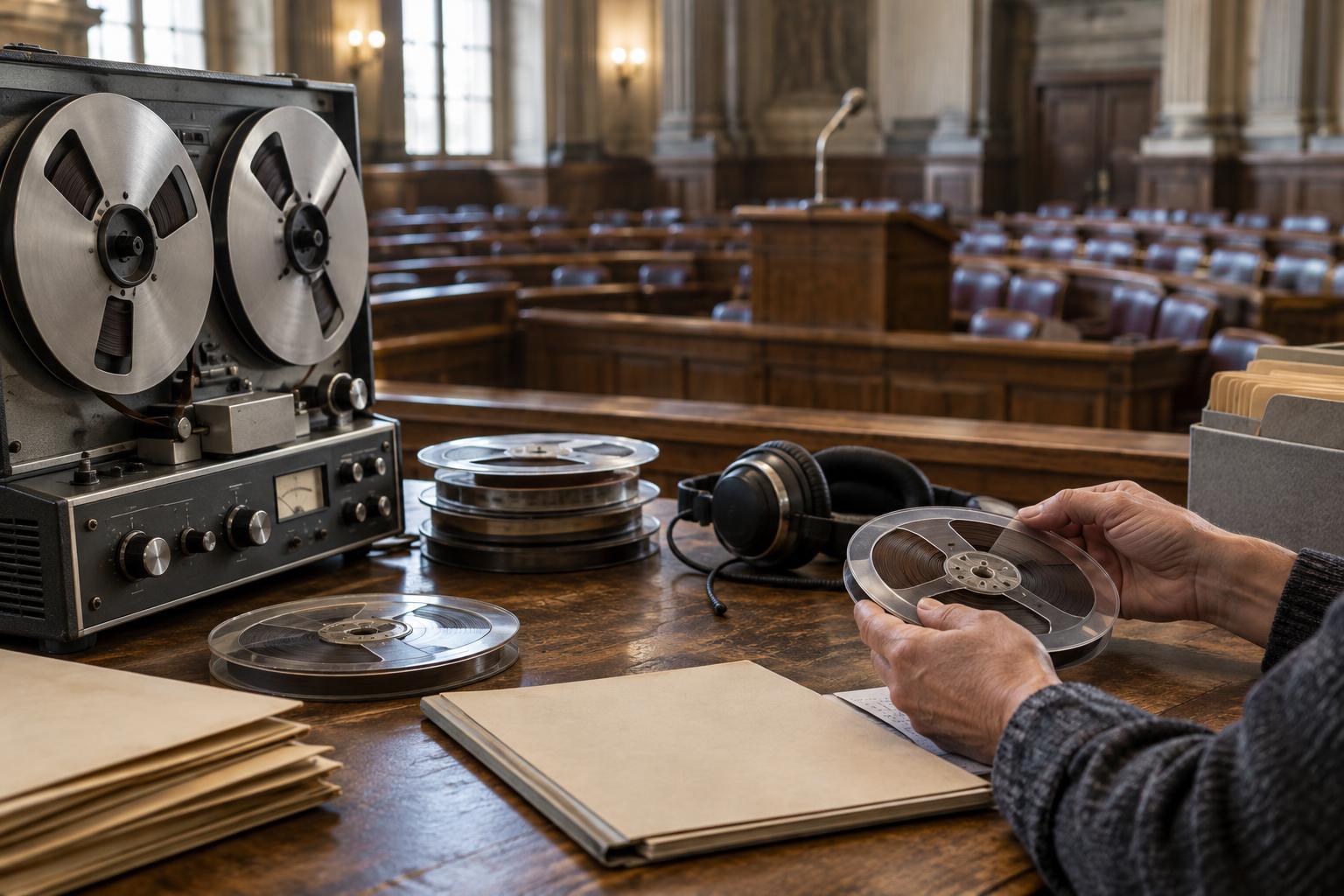
What a recording adds to the historical record
For much of political history, people encountered public arguments through conversations, printed accounts and speeches heard in person. A written text can preserve the words of a speech, but it cannot fully convey how the speaker delivered them. Recorded sound gives later listeners access to features that a transcript usually leaves out: pauses, emphasis, interruptions, applause and changes in tone. These details can help historians ask how a message was presented, not just what it said.
That does not make a recording a complete account of an event. A microphone captures sound from a particular position, and a surviving clip may contain only part of a longer exchange. Even when the recording is continuous, it cannot show every reaction in the room or tell us what listeners understood. Its value lies in the questions it makes possible, alongside the limits it imposes.
Who was recorded, and who was heard?
As recording and broadcasting became part of public life, political speakers could address audiences beyond the places where they appeared. Recorded speeches, interviews and debates also gave later generations a way to hear some of those encounters. But access to recording equipment and broadcast time was uneven. Officials and other prominent speakers were often more likely to be recorded and preserved than people speaking at smaller meetings or outside established institutions.
A collection of political audio therefore reflects choices made at several stages: what to record, what to broadcast, what to keep and what to make available. An absence of recordings does not mean an issue was unimportant or that no one spoke about it. When studying a period, it helps to ask whose voices are present, whose are missing and what other records might help explain the difference.
Listening with context, not just headphones
Before interpreting a political recording, establish what it is. Who appears to be speaking? Where and for what occasion was the sound captured? Is it a full event, an excerpt, a rebroadcast or a later compilation? A clip that begins with enthusiastic applause may suggest a warm reception, but without the surrounding material it may be difficult to judge how the whole event unfolded. Labels and descriptions are useful starting points, not substitutes for checking the recording’s history.
Next, distinguish what can be heard from what must be inferred. A speaker may sound angry to one listener and forceful to another. Background noise might come from an audience, a recording fault or a later transfer. Comparing the audio with a transcript, an event program or accounts from different participants can clarify basic details while revealing disagreements worth investigating. The goal is not to remove every uncertainty; it is to make clear which conclusions the evidence can support.
Why the physical and digital record matters
Political sound may survive on a physical carrier, in a digital file or in several versions made at different times. Each version can affect what a listener hears. Wear, playback equipment, editing and audio cleanup may alter the sound or obscure how an excerpt relates to the original event. For historical interpretation, information about the recording’s origin and later handling can be as important as the audio itself.
Readers interested in the everyday care of one physical audio format can browse Vinyl Care · Amsterdam Vinyl Journal; handling a record, however, is different from establishing the origin or completeness of a political recording. For that, look for descriptions of how the audio was made, copied and preserved. When those details are unavailable, a careful account says so rather than treating a clear-sounding voice as proof of an unbroken record.
Recorded sound makes political history more audible, but it does not make it self-explanatory. Heard alongside documents and accounts from other perspectives, it can deepen our understanding of how political messages were delivered and received—while reminding us that every surviving recording is only part of a larger public conversation.