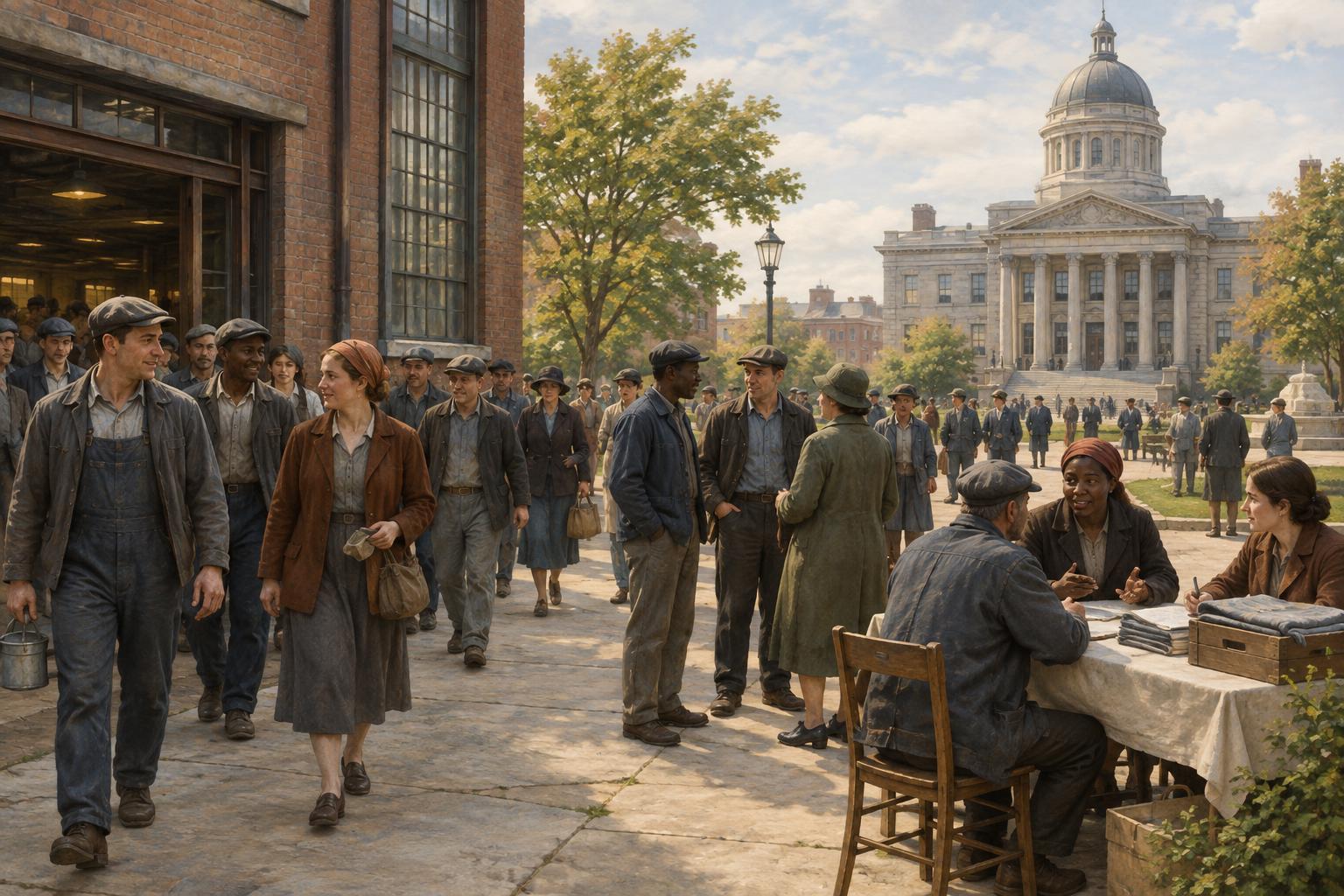
From workplace concerns to public questions
A labor movement is not a single organization. It can include trade unions, worker associations, mutual aid societies, political parties and informal campaigns. These groups have pursued different goals, but many began with a shared observation: decisions made at work affect life beyond the workplace. Wages shape housing and family choices; hours affect education and civic involvement; injuries and unemployment can leave households without reliable support.
As industrial employment grew in many societies, workers sought ways to negotiate collectively rather than only as individuals. A dispute over pay or safety could become a public question about who should set workplace rules and who should bear economic risks. That shift helped bring labor issues into elections, legislatures and public administration. Its path was rarely smooth: employers, governments and workers themselves often disagreed about the proper role of collective action.
Building routes into political participation
Worker organizations offered members practical experience in civic life. Meetings required people to debate priorities, elect representatives, raise funds and decide how to act together. Campaigns could teach participants how to petition officials, speak in public and follow proposed laws. These activities did not make every workplace democratic, but they created routes into politics for people who might otherwise have had little influence over public decisions.
Labor groups also pressed for a stronger political voice through electoral campaigns and alliances with parties. In some places, they supported broader voting rights and made working conditions a visible issue for candidates. Elsewhere, organizing faced severe restrictions, or voting rules excluded many workers. Labor movements could be divided by occupation, gender, race, citizenship or ideology. Their contribution to participation is therefore best understood as a contested process, not a steady expansion that reached everyone equally.
Putting social protection on the agenda
Early worker associations sometimes collected contributions to help members during sickness, injury or unemployment. Such mutual aid could offer valuable support, but a group’s resources were limited, especially when many members needed help at once. The gap between individual need and collective capacity helped fuel arguments for wider systems of protection funded or regulated through public institutions.
Labor advocacy contributed to debates over workplace safety, limits on working hours, compensation for injuries, unemployment support and income in old age. These policies did not arise from labor organizing alone. Reformers, employers, religious groups, civil servants and political leaders could support, reshape or oppose them for different reasons. Economic conditions and state capacity also mattered. Labor movements’ distinctive role was to keep workers’ experiences in view and to organize sustained pressure around them.
Why outcomes differed
Similar demands could produce different results depending on political institutions. Voting rules affected whether workers could reward sympathetic candidates. Rules governing unions and strikes shaped how safely people could organize. A centralized government might adopt a broad national program, while a more decentralized system might produce regional or local differences. The relationship between unions and political parties also influenced whether demands became legislation or remained outside government.
The makeup of the workforce mattered too. A policy designed around steady, full-time employment might leave out agricultural workers, domestic workers or people moving between jobs. Some labor organizations fought those exclusions; others initially concentrated on their own members. Studying who was included in a reform, and who was not, reveals more than treating its adoption as a simple victory or defeat.
A useful way to read labor history
Labor history connects everyday concerns to large political changes. To understand a particular movement, ask what problem its members identified, what tools they could legally use and which other groups supported or resisted them. Then compare their goals with the policy that emerged. A law may reflect compromise, and its effects may depend on enforcement as much as its wording.
This approach avoids treating social policy as a gift from leaders or as the inevitable result of economic change. It also avoids assuming that a movement spoke for all workers. Labor movements helped shape political participation by organizing people to act collectively and helped shape social policy by making workplace insecurity a public concern. How far that influence extended depended on the institutions, alliances and exclusions of each place and period.