What makes a source primary?
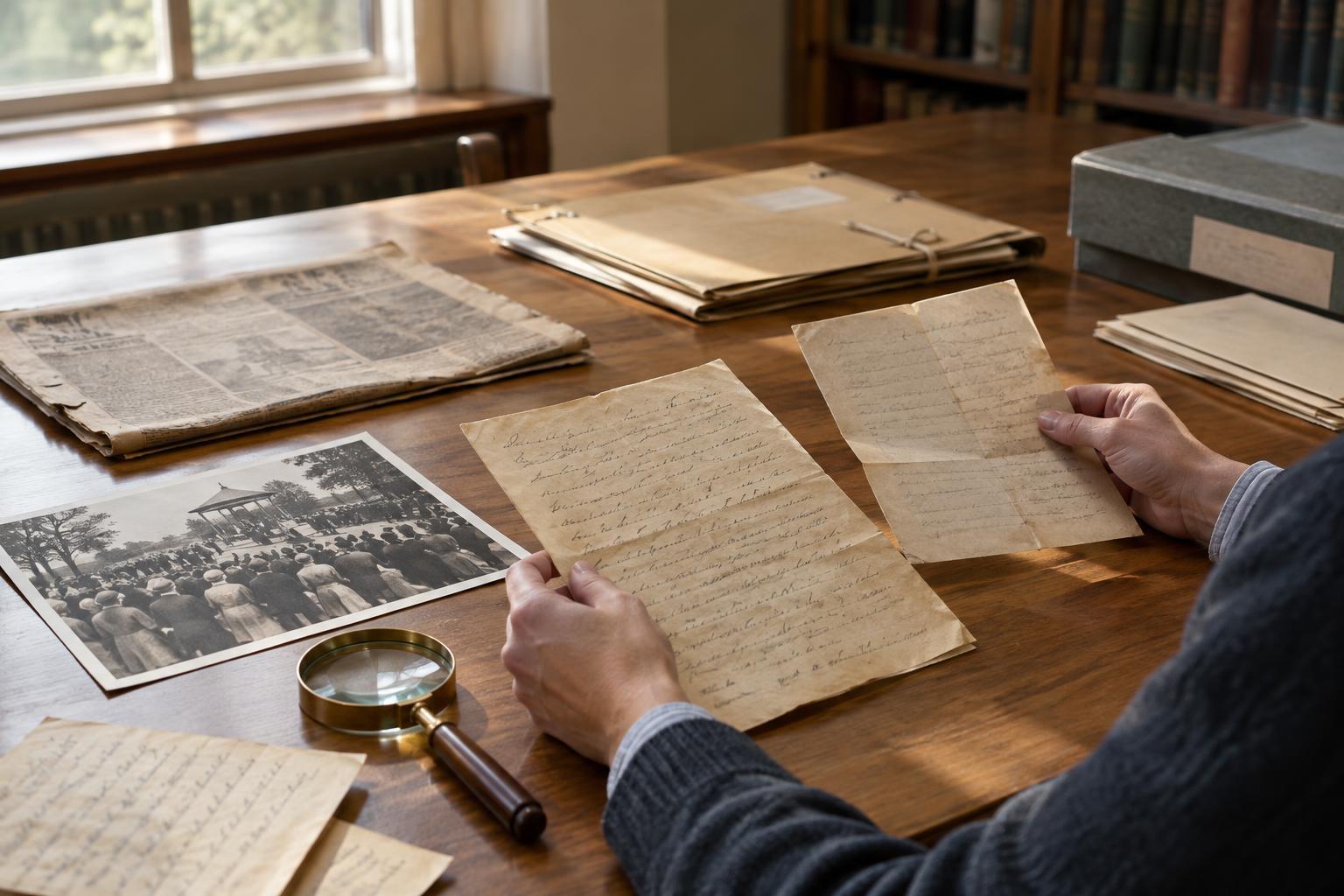
A primary source is material created by someone who participated in, witnessed or recorded the period or event you are studying. In political history, it might be a law, a campaign leaflet, a speech, a meeting record, a newspaper report, a letter or an oral history interview. A photograph or poster can also be a primary source. The label depends on your question: a later textbook is usually a secondary account of an election, but it could be a primary source for a study of how that election was taught years afterward.
Primary does not mean complete or automatically reliable. A law can show what officials formally approved, but not whether people followed it. A campaign leaflet can reveal the argument a group wanted voters to hear, but not what every voter believed. The value of a source lies partly in knowing which questions it can answer and which it cannot.
Start with a question, then choose sources
A focused question makes source selection easier. Instead of asking, “What happened in this political movement?”, you might ask, “How did its leaders explain a proposed reform?” That question points toward speeches, pamphlets and statements. If you want to know how a policy worked in practice, administrative records, correspondence and accounts from affected people may be more useful.
As you search a library catalogue, archive or digitized collection, note the difference between a document and its description. A catalogue summary can help you find a source, but it is not a substitute for reading it. Check whether you are viewing a complete item, an excerpt or a transcription. If a page is missing or a word is difficult to read, record that uncertainty rather than guessing.
Read the source in its setting
Before interpreting a document, ask who created it, when, for whom and for what purpose. A public speech and a private letter by the same person may sound different because they had different audiences. Also ask who preserved the item and how it reached you. An edited collection may make important material accessible while selecting only part of a larger record.
Pay attention to the language available to people at the time. A familiar political term may have carried a different meaning in its original setting. Notice what problem the source identifies, what it assumes the audience already knows and what action it seeks. These questions help you read it as evidence of a particular situation, not simply as a statement to accept or reject.
Context should clarify the source without excusing every claim it makes. If a document uses a stereotype or excludes a group, acknowledge that directly. Then ask how those words may have shaped political choices or reflected limits on participation. Quoting a short passage accurately and explaining its setting is usually more informative than removing troubling language from view or repeating it without explanation.
Compare evidence and notice what is missing
One document rarely settles a historical question. Compare sources made by people in different roles: officials and residents, supporters and opponents, leaders and local organizers. Look for agreements as well as disagreements. If a speech promises a reform and a later record describes its administration, the two sources can help you distinguish an announced goal from an implemented measure.
Contradictions do not always mean that one source is useless. People may have had different information, interests or access to decision-makers. Nor does agreement always prove an account is complete; writers might rely on the same report or share an assumption. Keep track of what each source directly shows, what you infer from it and what remains unclear.
Archives also have silences. Some people left few written records, while institutions preserved large quantities of their own paperwork. A missing voice is not proof that those people had no views or political influence. Where possible, widen the search to include oral accounts, community publications, petitions or records in which people’s actions appear indirectly. Be cautious about speaking for people whose perspectives the surviving evidence does not capture.
Build a clear, checkable interpretation
When you write, make a claim your sources can support. “This leaflet presents reform as a question of public order” is narrower and easier to test than “Everyone supported reform for the same reason.” Identify the source behind each important point, using enough detail for a reader to locate it: creator, title or description, approximate date if known, and the collection or publication where you found it. If you use a transcription or translation, say so.
Separate description from interpretation. First explain what the source says or depicts; then explain why you think it matters to your question. Acknowledge limits, especially when a document is fragmentary or its audience is uncertain. This approach does not make political history less interesting. It lets readers see how an argument was built—and leaves room to revise it when new evidence comes to light.